
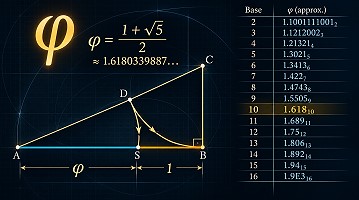
We know the golden ratio as 1.618…, but that’s base 10. Toyne Harris wrote to ask if it works in other bases, so let’s explore that question.
The golden ratio flows from essential concepts and constructions in geometry that have nothing to do with its numeric value or mathematical properties and representations:
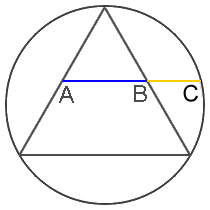
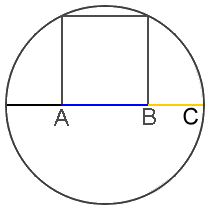
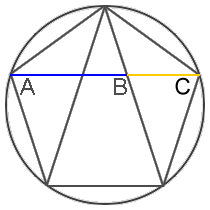


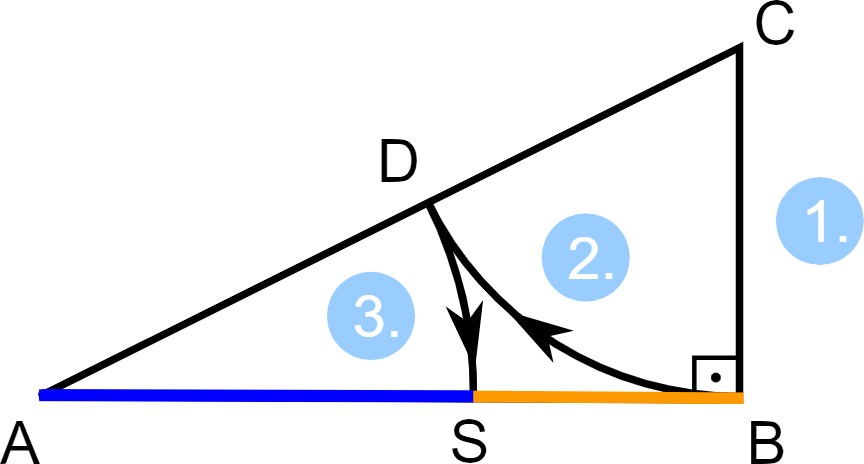
https://www.goldennumber.net/geometry/
https://www.goldennumber.net/circles/
https://www.goldennumber.net/category/geometry/
The golden ratio is commonly written as 1.618…, but that familiar sequence of digits is not an intrinsic property of the golden ratio. It is simply how the number appears in our base-10 decimal system.
There’s an interesting subtlety, though: three digits in each base does not actually provide the same numerical precision.
Three binary fractional digits give only (2^{-3}=1/8) resolution, whereas three hexadecimal digits give (16^{-3}=1/4096). So 1.100₂ is much less accurate than 1.618₁₀, while 1.9E3₁₆ is substantially more accurate.
Change the number system, and the digits change. In binary (base 2), for example, approximately the same degree of precision requires 1.1001111001. In base 12 it can be written as 1.75, while in hexadecimal (base 16) it becomes approximately 1.9E3, where E represents the value fourteen.
This illustrates an important distinction. The golden ratio itself—φ = (1 + √5)/2—is independent of any number system. Its value and mathematical properties remain exactly the same whether we express it in base 2, base 10, base 16, or any other base. Only the symbols we use to represent that value change.
interestingly, the number of digits required in each base to give the same precision varies. Each additional base 2 binary digit divides an interval into two parts, while each base 10 decimal digit divides it into ten, and each base 16 hexadecimal digit into sixteen. Thus, lower-number bases generally require more digits to express a value with comparable accuracy.
The familiar 1.618, then, belongs to our decimal notation. The golden ratio itself belongs to mathematics and geometry.
| Base | Golden ratio approximation | Fractional digits |
| 2 | 1.1001111001₂ | 10 |
| 3 | 1.1212002₃ | 7 |
| 4 | 1.21321₄ | 5 |
| 5 | 1.3021₅ | 4 |
| 6 | 1.3413₆ | 4 |
| 7 | 1.422₇ | 3 |
| 8 | 1.4743₈ | 4 |
| 9 | 1.5505₉ | 4 |
| 10 | 1.618₁₀ | 3 |
| 11 | 1.689₁₁ | 3 |
| 12 | 1.75₁₂ | 2 |
| 13 | 1.806₁₃ | 3 |
| 14 | 1.892₁₄ | 3 |
| 15 | 1.94₁₅ | 2 |
| 16 | 1.9E3₁₆ | 3 |