Creating a Triangle based on Phi (or Pythagoras meets Fibonacci): Pythagoras discovered that a right triangle with sides of length a and b and a hypotenuse of length c has the following relationship: a² + b² = c² A foundational equality of phi has a similar structure: 1 + Phi = Phi2 ( 1+ 1.618... = 2.618... ) By taking the square root of each term in this equality, we … [Read more...]
Geometric constructions of Phi in Circles
Phi appears in a number of geometric constructions using circles. There are a number of geometric constructions using a circle which produce phi relationships, as described below. Among mathematicians, there's a bit of a competition to see how few lines can be used to create a phi proportion, or golden section, in the construction, or how many golden sections can be created … [Read more...]
Bucky Balls and Phi
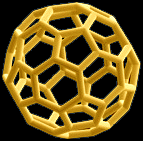
Bucky balls are based on sixty coordinates all based on phi. Bucky balls are named after Buckminster Fuller, who popularized the geodesic dome. The shape defined by Bucky balls is also found in the Carbon 60 molecule, a form of pure carbon with 60 atoms in a nearly spherical configuration, the truncated icosahedron and soccer balls. Bucky balls consist of 60 points on the … [Read more...]
DNA spiral as a Golden Section

The DNA molecule, the program for all life, is based on the golden section. It measures 34 angstroms long by 21 angstroms wide for each full cycle of its double helix spiral. 34 and 21, of course, are numbers in the Fibonacci series and their ratio, 1.6190476 closely approximates phi, 1.6180339. B-DNA has spirals in phi proportions DNA in the cell appears as a … [Read more...]
Fibonacci Numbers and Spirals in Plants

Plants illustrate the Fibonacci series in the numbers and arrangements of petals, leaves, sections and seeds. Fibonacci numbers in plant spirals Plants that are formed in spirals, such as pinecones, pineapples and sunflowers, illustrate Fibonacci numbers. Many plants produce new branches in quantities that are based on Fibonacci numbers. Fibonacci numbers in plant … [Read more...]
The Golden Section in Nature: Animals
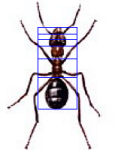
There are many examples of the Golden Section or Divine Proportion in nature. Below are just a few: The eye, fins and tail all fall at golden sections of the length of a dolphin's body. The dimensions of the dorsal fin are golden sections (yellow and green). The thickness of the dolphin's tail section corresponds to same golden section of the line from head to tail. The … [Read more...]
Golden Ratios in Body Temperatures
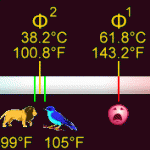
Body temperatures and sterilization points fall near the phi points between freezing and boiling. Body temperatures vary, even within humans. The body temperatures of mammals range from around 97° to over 103° Fahrenheit. Birds have average temperatures of around 105° Fahrenheit. The phi point between the freezing temperature (32° F) and the boiling temperature (212° F) … [Read more...]
Human Heartbeat and Fibonacci Patterns
A peaceful heartbeat is said by some to beat in a Phi rhythm. The prominent parts of an electrocardiogram (ECG or EKG) are the P wave, a deflection caused by the current originating in the atrium; the QRS complex, showing the passage of the electrical activity into the ventricles; and the T wave, as the ventricles reset themselves. The electrocardiograms (ECG or EKG) of human … [Read more...]
Human Growth and Development

Fibonacci numbers define key points in human aging. Fibonacci numbers mark key points in the human aging and development process, as illustrated in the following table, based on insights provided by Norman S. Rose, Ph.D. at his site at http://whizkidz.org: Human Age Development Stage Key … [Read more...]
Human Teeth and the Golden Ratio

Phi is found in the dimensions of the teeth, mouth, lips and even your smile. For several decades, Dr. Eddy Levin of the U.K. has used the concept of phi to design aesthetically pleasing cosmetic and orthodontic corrections in the field of dentistry. Dr. Levin's principles are compulsory study in many American Dental Schools. The images below show several how phi … [Read more...]