
The human body is based on Phi and 5.
The human body illustrates the Golden Section or Divine Proportion. We’ll use the golden ratio building blocks developed on the Life page again for each line segment:


 The Divine Proportion in the Body
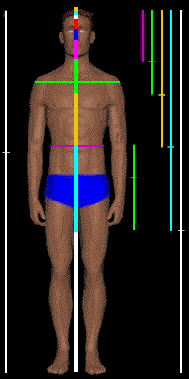 The Divine Proportion in the Body
- The white line is the body’s height.
- The blue line, a golden section of the white line, defines the distance from the head to the finger tips.
- The yellow line, a golden section of the blue line, defines the distance from the head to the navel and the elbows.
- The green line, a golden section of the yellow line, defines the distance from the head to the pectorals and inside top of the arms, the width of the shoulders, the length of the forearm and the shin bone.
- The magenta line, a golden section of the green line, defines the distance from the head to the base of the skull and the width of the abdomen. The sectioned portions of the magenta line determine the position of the nose and the hairline.
Although not shown, the golden section of the magenta line (also the short section of the green line) defines the width of the head and half the width of the chest and the hips.
The Human Body is based on patterns of 5, which is the basis for Phi as well

Another interesting relationship of golden section to the design of the human body is that there are:
- 5 appendages to the torso, in the arms, leg and head.
- 5 appendages on each of these, in the fingers and toes
- 5 openings on the face.
- 5 sense organs for sight, sound, touch, taste and smell.
The golden section in turn, is also based on 5, as the number phi, or 1.6180339…, is computed using 5’s, as follows:
5 ^ .5 * .5 + .5 = Phi
In this mathematical construction “5 ^ .5” means “5 raised to the 1/2 power,” which is the square root of 5, which is then multiplied by .5 and to which .5 is then added.

Interesting.
I have used this ” GOLDEN RATIO ” in Dental Technology
Me too Aaron 😀
does anyone have any more information about the relationship phi and the human body? is there any books specifically about it? because i am currently doing an internal assessment ( a kind of research) and my topic is the relationship of phi/golden ratio and our human body 😀 ? thank you all
This video may give you some points to measure:
https://www.youtube.com/watch?v=kKWV-uU_SoI
Does anyone have or know of any website that I can get info. from abut the golden ratio in relation to the human body?
What is the connection of Hermes to the Golden ratio?
Hello, I’m also doing an internal evaluation on this aspect. Can I borrow your topic for reference? I don’t have any ideas for choosing the topic now.
Hi Evelyn, I really hope you see this! I currently have to write an Internal Assessment in maths, and I was wondering if you ever wrote that essay?
ok but how does this affect LeBrons legacy?
cool
My recent overview of this website has lead me to wonder if the human heartbeat has a direct corelation to phi. Perhaps in the measured longevity of the beat as well as the actual sound pattern.
Interesting
You have a point there.
You tube. I forget the name of the vid … Sacred geometry from memory, longish video and dude is a little full of himself and seems like wishful rubbish but in the end demonstrates interesting discoveries culminating in, seemingly, wonderous connection between his discoveries an the shape of the human heart.
. I found that vid to be an interesting watch anyways.
The Constance of our heartbeat is Pi, which has a correlation to the golden mean.
very good nice
everything is in mathematics – example the human body
That is freaky in a cool way
really
VERY VERY COOL!!!
It strikes me so very interesting that as a young artist I was already learning the proportions of the human body so that I could draw a reasonably realistic figure, but in my case I learned the proportions from sources which used a more general fraction than the detailed decimal number shown in this site–that is, from books and teachers all the way back to grade school (and then, after going to the Fox Lane Junior High School in Upstate N.Y. and Long Island City High School in Queens, N.Y., I attended the Pratt Institute Art School for both my bachelor’s and master’s degrees and all the way through we had six-hour drawing classes each week and drew from nude models).
For example, when it comes to limbs, it was this way: The lower arm or forearm is two-thirds the length of the upper arm, which is longest; the hand (palm plus longest finger) is two-thirds the length of the forearm; each part of each finger, from longest to shortest, is two-thirds the length of each segment of the part of the finger before it, starting from where the finger is attached to the palm. This two-thirds proportioning is also applied to the feet, running from the upper leg bone to the lower leg bone to the foot. And, the artist generally uses the head of the individual to describe his or her height, although the basic general height of a generalized person is eight heads tall.
That’s why the “phi” and “fibonacci” as well as the “golden mean” caught my attention at this site. Actually, I originally set out to find out how to figure out the exact length of each limb (so I could get accurate lengths for shirt sleeves and pants), and that’s how I and this site crossed paths! You have to remember, too, that the artist does not stop to do mathematical calculations–the artist simply uses his sharp trained eyes, and so two-thirds is much easier to determine with the eyes than 1.61804 or 61.8%. By the way, the fraction two-thirds reduced to a decimal works out to .66666… or 66%.
Still, the artist is not viewing decimals; the artist views relationships through visual determination, and note, too, that art teachers or drawing instructors are always urging their student-artistes to exaggerate both the sizes of the body parts and the angles of a model’s poses! Meanwhile, the artist is certainly aware of the “golden proportion”, as it is named here. Ah! wonder of wonders, miracle of miracles!!! For li’l ole me (I just turned 65 on May 5th), ’twas once upon a time and long ago!
Oh wow, Thank you for your comment.
Your comment is made this page even better!
That is a long comment… it took me a while to read 😀
Thanks for your input. It opened a new perspective for me. Being an artist seems cool and your mathematical / artist insight added to the magic of the article. Keep it up honey!!!!
i like it because it has a lot of information.
Absolutely brilliant article. “In the beginning was the word, and the word was God” is referring to what I believe to be the word = sound = vibration. Have you seen the videos of sand on a speaker plate forming intricate patterns from the specific tunings of the sound? The beginning of the universe was formed from vibration which organizes matter into patterns. Ancient cultures knew this.
Pythagoras would have you fast 40 days on water just to enter his Pythagorean academy. He would then give you a “sacred meal” known as Pulse (as mentioned in Daniel 1:12 in the bible) he referred to it as “the meal of hercules” it was a sprouted fruit nut grain meal that was prepared to the phi ratio. ancient cutlures knew that food prepared in this way was perfect for the body.
Can anyone tell me where on the human body can be found the exact golden ratio point? Would be at the heart?
I must say that the common believe in the five senses of the human body is, in fact, not true. We have more than 5 senses (and I’m not referring to the paranormal “eye” which some people believe in).
We have, for example, the sense of temperature, which is not the same as touch. The sense of pain is somehow related to touch but not quite the same.
The sense of pressure.
The sense of proprioception (which makes you able to know where your body parts are while closing your eyes).
The sense of balance.
….
Senses are, in fact, the human body taking information about the enviroment and processing this.
The 5 5 5 5 thing is just mere coïncidence, or in other words, searching for something that is not there.
Good point on human senses. The page has been corrected to say “five sense organs” rather than “five senses” to make it accurate. How do you determine what is coincidence and what is not? It’s possible to search for relationships that do not exist, but also possible to chose to dismiss those that do. Our underlying beliefs strongly influence how we see the evidence.
Is the stomach not a sense organ? Hunger, nausea, connection to others, nervousness etc. Are all felt in the stomach.
Your lungs sense pressure change and humidity.
Yes, that’s true. I see that the traditional list of five senses has now been expanded to as many as twenty-one. See http://www.todayifoundout.com/index.php/2010/07/humans-have-a-lot-more-than-five-senses/.
thats amaZING
For as long as I’ve been researching the Golden Section and related phenomenon- its still a bit of a hurdle to expect an absolute (even a proportional one) to occur in all humans. Even described simply- any pairing of normal human beings– with two eyes, two arms, two legs, nose, ears, mouth etc etc etc– seldom look the same. The great diversity of people on earth who belong to the same species is amazing. As much as I hate to ignore my intuition and numerous spiritual experiences, I can’t help but to desire a formula- at the very least, a guideline within which phi would occur unerringly. I doubt that’s going to happen, at least not within my current mathematical abilities- but in the meantime– if your trust your eyes as well as your math– check out the “test” I did in the video posted above. Not what I expected– but still fascinating.
Great video! Please share more of your work here. One exception regarding your conclusions: See the Birth of Venus on the Botticelli page as analyzed in high resolution. I don’t think anyone takes the position that all humans conform to the golden ratio in all their proportions. It’s just the proportion that seems to appear with frequency and that is often related to perceptions of beauty.
Thanks Gary! To be honest- I started off expecting to get a lot more yeses than nos- but felt I had to share the result one way or another. The final result being so close to 1.6:1 (even if not in the desired direction) was an odd surprise though. About beauty– often in the eye of the beholder– I’d be curious to hear from others, but in many cases (Lindsay Lohan for one) it seemed like those bodies which did conform to the Golden Ratio had the navel too high for my tastes– an odd observation I know– but after going through so many pics, couldn’t help but notice. Also- as the type of photos available tended to be celebs and professional models- I couldn’t help but wonder about different races and- shall we say– less “fit” family lines.
I actually found this after I had completed the video, but if any one else is interested, this study actually came to the opposite conclusion as I did: http://www.fq.math.ca/Scanned/17-4/davis-a.pdf I will definitely share more of my research in a future video- I just feel the need to apologize ahead of time for the 1998 slideshow tech level! 😉
AWESOME. VERY INFORMATIVE.
superb
Interesting.Have to learn it
Way cool God’s opening up a new realization and inspiration for us to find that everything He designed can be reduced to numbers (mathematics – the universal language); even His word. it’s all going to end in PERFECT BEAUTY, which is HIM! 🙂 If this piques your interest, read Bonnie Gaunt’s book, Jesus Christ and the Number of His Name; The Amazing Number Code in the Bible; also Theomatics’ by Lucas and Washburn. God bless
So…. you’re a believer Dawn???????? Just wondering…. cuz that’s way cool, I’m a believer, too!!!!!!!!!!! 🙂
this is really cool
I like the way of the mathematical instructions are given.great Job indeed!!!!!!!!
amazing
this nimble artical was very revealing.
The golden ratio appears so often in nature so often eg
Ammenites,flower petals, some tree species etc etc that it has to be more than a mere coincidence….God had a scientific calculater. FACT!
When I was younger in GT class, I think like 5th grade actually, we did this project on the golden ratio and we measured everyone in the class. I turned out to be the only one that had the golden ratio. Our teacher also had us see how many letters are in each part of our names. Mine is Jaime Pablo Lopez which is 5, 5, 5. So we were all trippin by then. And I I don’t know some wierd stuff has been going down in my life since then, I mean like not anything crazy but ya know, I just always been wanting some input ?
Hi Jamie,
I’m curious to know what your birthday is? What is your Life path number? Numerology has more available information that might guide you to infinite possibilities that align well with the unique imprinted energy we are all born with. Is there 5′ s in your Lp# birthday #s ?
This has been a great read, thank you!
“May all of life come with ease, joy, and glory!”
If a painter uses the Divine Proportion and represents a human figure with a height of 2.6 feet, which of the following would measure 1 foot in length?
The most common answer would be the distance from the navel to the top of the head. The ratio of 1.0 to 2.618 is the same as 0.382 to 1.0, so it defines the golden ratio of the height.
very informative it certainly proves that every thing is in accord in balance , yet surviving in a element of discord. I have done my own research on the symmetric aspects of the human body and have found the golden Ratio to be very accurate. further to your findings , I have discovered additional a /symmetrical/mathematical measurements of the human body,
The length of the human face is equal to the length of the human hand.
The circumference of the calf muscle is equal to the circumference of the neck.
The distance from the centre of the sternum to the elbow is exactly half the distance as from the centre of the sternum to the FINGERTIPS.
The length of the nose is exactly 1/3 the length of the face. The distance from the tip of the nose to the chin is equal to the length of the nose. The distance from the top of the nose to the hairline is equal to the length of the nose. (the golden ratio )
In the male within the human species; The distance from the human coxyn to the top of the shoulders. is 3 times the length of the foot ( as from the heal to the top of the ball of the foot )
The width of the person’s shoulders. 4.7 times the with of the ball of the foot..
The width of a persons hips is 4.7 times the width of the heal.
So it can be concluded that the width of the foot is in direct proportion to the width of the human torso.
This is all so interesting!
This is all very interesting.. I am a violinist and have seen that the proportions on the making of a violin have almost on every corner the Golden ratio.. But at the beginning some VIOLINMAKER had to sit down and design this masterpiece. The sound inside travels also from this construction so that the best quality and quantity of sound can be produced. With all this knowledge and precision and patience a beautiful instrument is created and not evolved from matter.. It takes a humble step to see the magnificent MAKER behind the human body and the whole of creation even to the ends of the universe. This Mastermind that we Christians call God is greater and more intelligent than any of us and yet people assume this all came about by itself. In the beginning was the Word.. From dead matter to the high complex information that is needed to make even one protein in our body’s system, Is for me as a normal intelligent person, shear impossible…
With all these thoughts think of the small instrument maker, the next time you go to a beautiful concert and maybe you will finally realize, while listening to the concert, the Great Maker who is behind the whole of creation.
may i ask, does everyone havae a golden ratio? Because we have a assessment to measure some parts of our body which have golden ratio but I when I divide those values I can’t even get phi value ?
Not everyone will have golden ratios in their proportions, but most people will have some proportions that are very close. The key thing is to know where to look for them. See these articles for guidance:
https://www.goldennumber.net/meisner-beauty-guide-golden-ratio-facial-analysis/
https://www.goldennumber.net/facial-beauty-golden-ratio-photo-analysis/
https://www.goldennumber.net/human-body/
Thank you so much.
ever wonder why the very best(eg athletes,etc) and the healthy have close symmetry between left and right mirroring? contemplate
left and right, hands and feet.
bipedalism, momentum, ambidextrous-footness.
big knuckles connected to your….big foot knuckles. knees connected to your….elbows. break that down for each joint and connect them all together.
another example:
fingertips connected to your….toe tips, wrists connected to your….ankles.
your head, neck, ex/internal cavities. contemplate and read below.
you are what you do, and your body always remembers, TENSION.
now those measurements make sense? performance nothing to do with a balance of each segments, between left and right? how we perform our daily tasks? metabolism?
visible difference between 6 pack abs and 10 pack abs? never seen a tri athlete with 6?
man and woman Made for each other?
maybe more than we like to confront and Know.
almost forgot to add, animals and nature. everything is connected, Everything. Tension
almost forgot to add, animals and nature. everything is connected, Everything. TENSION
add to above
20/20 vision
breathing
5 senses and their accompanying organs
TENSION
I don’t even know why i’m here i’m gotta do golden ratio for math class but its the last week of school so i’m boutta say screw it
Hi Leo,
Well to make the golden ratio more interesting, pick a topic you like and see how it might apply: Sports, beauty, history, nature, DNA, etc. Type any one of those into the Search bar at the top right of https://www.goldennumber.net.
And to see how other people apply it, try my software site page at https://www.phimatrix.com/applications/. Download the two week free trial and apply it to some photos – people’s faces, famous artwork, etc.
For an overview to get you started, see:
https://www.goldennumber.net/golden-ratio/
A few interesting videos:
https://youtu.be/kKWV-uU_SoI
https://youtu.be/nXDmAtTJ6JY
But if you just want the math try start here:
https://www.goldennumber.net/math/
https://www.goldennumber.net/geometry/
That should get you started, with a better head start than most everyone else in your class.
As Nike says, “Just Do It!”
the equation for PHI at the end of this article in wrong.
correctly,
PHI= .5 (.5 + .5 + ( 5 ^ .5 ))
or
PHI = (1/2) x ( 1 + sqrt5 )
The formula in article is correct, and quite simple. Copy and paste =5^.5*.5+.5 into Excel and it will produce 1.618034…
Your formulas are mathematically correct, but lack the simplicity and elegance of =5^.5*.5+.5
Sir!
You are quite correct!
but to be clear only ( .5 x ( 5 ^ .5 ) ) + .5 = PHI.
Thanks for setting me straight.
One big attraction of my first formula is that it uses five 5s
Hi Gary you are my idol, I love your book almost as much as I love you
Thank you, Grady. That’s quite a compliment. I’m glad that my site, software and book are such an inspiration.